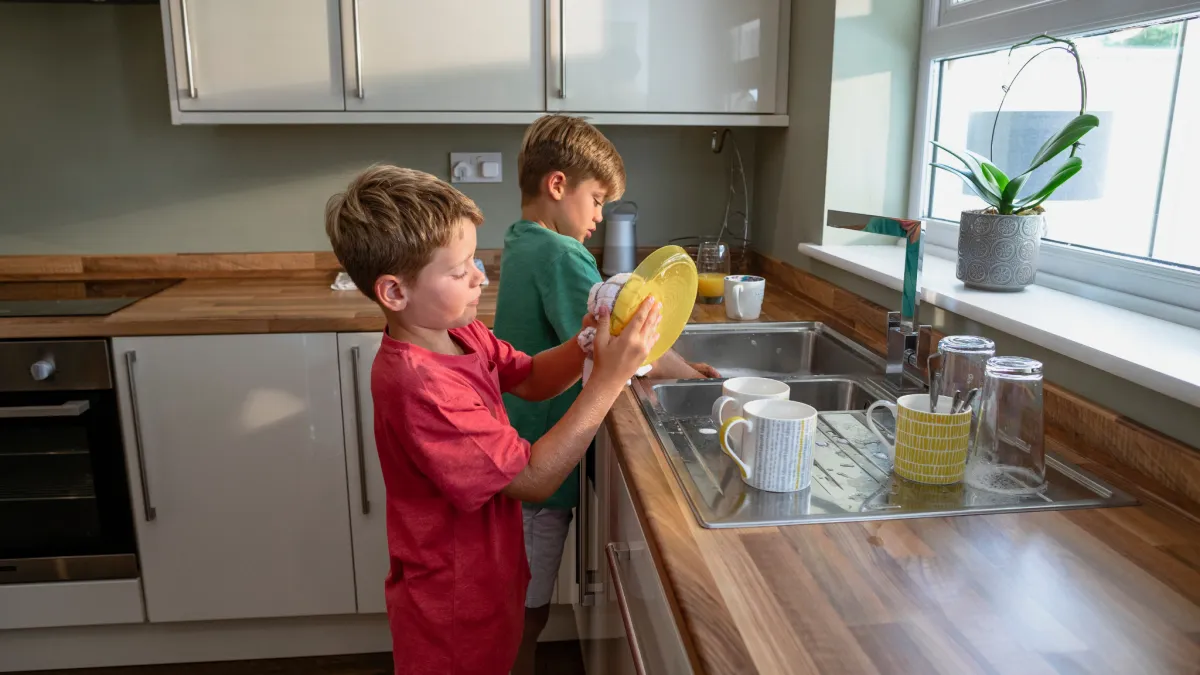
The Magic of "I Can Do It!": Why Small Responsibilities Build Big Confidence
Chandra Eden, The True Me Yogi
Home Education
Author: Charlotte Mason
“When children are given responsibilities and treated as capable people, they are more likely to behave responsibly. When we do too much for children, we can accidentally communicate that we don’t believe they are competent enough to handle things themselves.”
The Magic of "I Can Do It!": Why Small Responsibilities Build Big Confidence
"When children are given responsibilities and treated as capable people, they are more likely to behave responsibly. When we do too much for children, we can accidentally communicate that we don't believe they are competent enough to handle things themselves."
Parents often find themselves caught in a race against the clock.
It's faster to put on the shoes.
Faster to zip the jacket.
Faster to pour the milk.
Faster to clean up the toys.
Faster to do almost everything ourselves.
But while we're winning the race for speed, we may be missing something much more important: opportunities for our children to discover what they're capable of.
For children ages 3-9, confidence isn't built through praise alone. It's built through experience.
A child who successfully carries their plate to the sink begins to think, "I can help."
A child who remembers to feed the dog starts to think, "People can count on me."
A child who packs part of their backpack learns, "I can do hard things."
These small moments may seem insignificant to adults, but to children, they are building blocks of identity.
The Invisible Message We Send
Children are constantly learning about themselves from the way adults interact with them.
When we step in too quickly, even with the best intentions, children can sometimes receive an unintended message:
"Mom doesn't think I can do it."
"Dad thinks it's too hard for me."
"Someone else always has to fix things."
Of course, that isn't what parents mean.
Most parents help because they love their children.
But children often pay more attention to what we do than what we say.
If we always rescue, fix, carry, organize, remind, and solve, children may never get the chance to discover their own abilities.
Confidence Doesn't Grow in Comfort Zones
Imagine if someone carried you up every staircase because they were worried you might trip.
At first it might seem helpful.
After a while, you might start wondering if you were capable of climbing stairs at all.
Children are no different.
They need chances to try.
They need chances to struggle.
They need chances to make mistakes.
Most importantly, they need chances to succeed after struggling.
That is where confidence grows.
Not in perfection.
Not in constant help.
But in trying, learning, and figuring things out.
The NLP Perspective: Building an Identity of Capability
In Neuro-Linguistic Programming (NLP), we understand that children create beliefs about who they are from repeated experiences.
If a child repeatedly experiences:
"Someone else will do it for me."
They may begin to believe:
"I need help."
"I can't do things on my own."
"Other people are more capable than I am."
But when a child repeatedly experiences:
"I tried."
"I learned."
"I solved it."
"I helped."
They begin creating a very different identity:
"I am capable."
"I can learn."
"I can handle challenges."
These beliefs become powerful guides for future behavior.
Start Small, Think Big
Responsibility doesn't have to mean complicated chores.
For younger children, it might look like:
Putting toys in a basket
Carrying napkins to the table
Feeding a pet with supervision
Putting dirty clothes in a hamper
For older children, it might include:
Packing their backpack
Helping prepare snacks
Watering plants
Setting the table
Choosing tomorrow's clothes
The goal isn't perfection.
The goal is participation.
Let the Mess Be Part of the Lesson
Sometimes responsibility comes with spilled milk.
Sometimes shoes end up on the wrong feet.
Sometimes towels get folded into shapes that resemble modern art.
That's okay.
Learning is messy.
Children don't gain confidence because they perform tasks perfectly.
They gain confidence because trusted adults believe they can learn.
When we allow room for mistakes, we show children that competence is not something they're born with. It's something they build.
The Gift That Lasts
Every time you say:
"You can do it."
"Give it a try."
"I believe in you."
You are giving your child something far more valuable than help.
You are giving them evidence.
Evidence that they are capable.
Evidence that they can learn.
Evidence that they can handle challenges.
And over time, those pieces of evidence become something extraordinary:
A child who believes in themselves.
That's a gift that will serve them long after the toys are picked up, the backpacks are packed, and the milk spills are forgotten.
